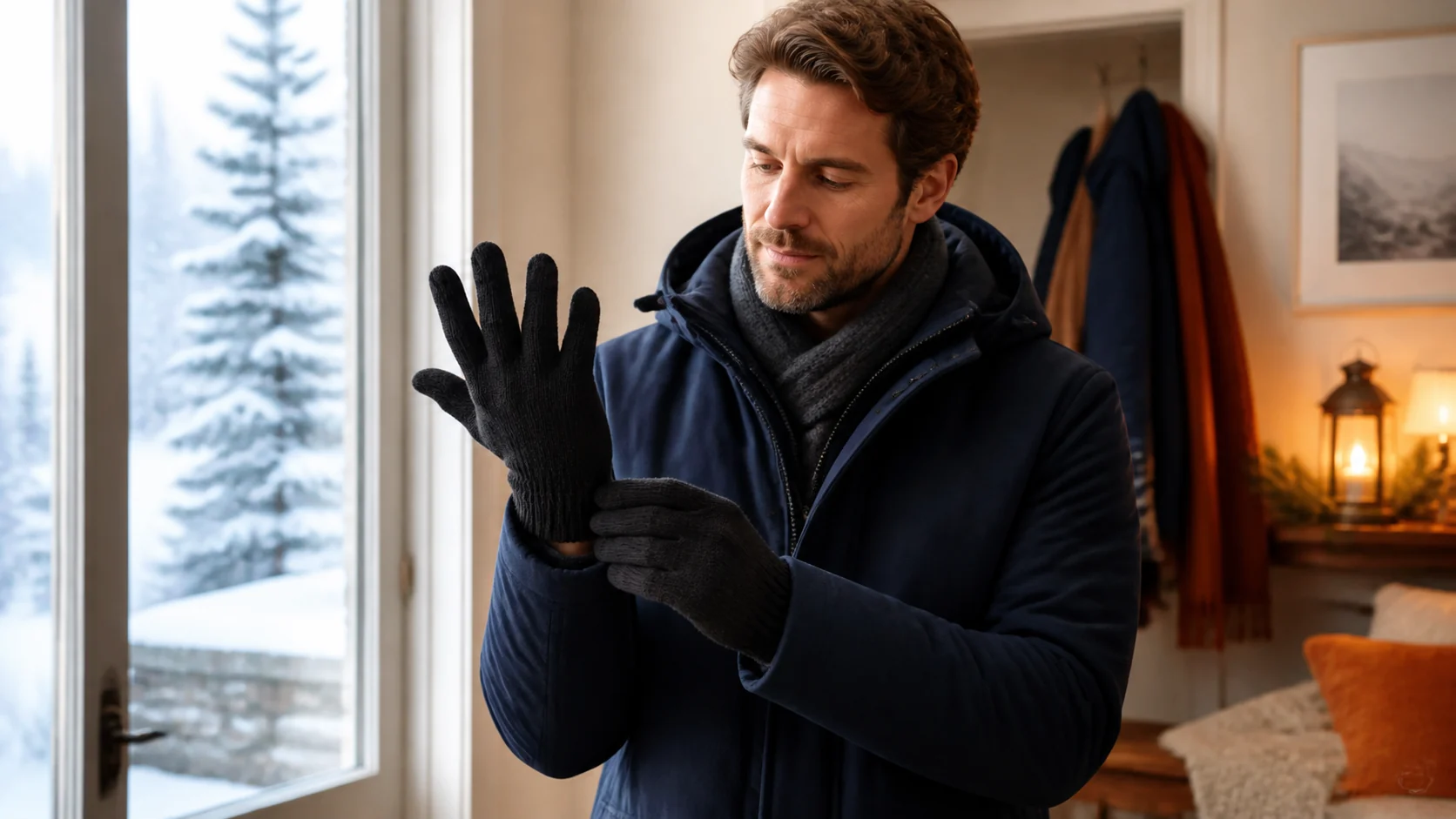


Winter glove liner decision guide
Do Glove Liners Actually Keep Your Hands Warmer?
They can—but only when the outer glove has enough room, the system manages moisture, and the liner matches the job.
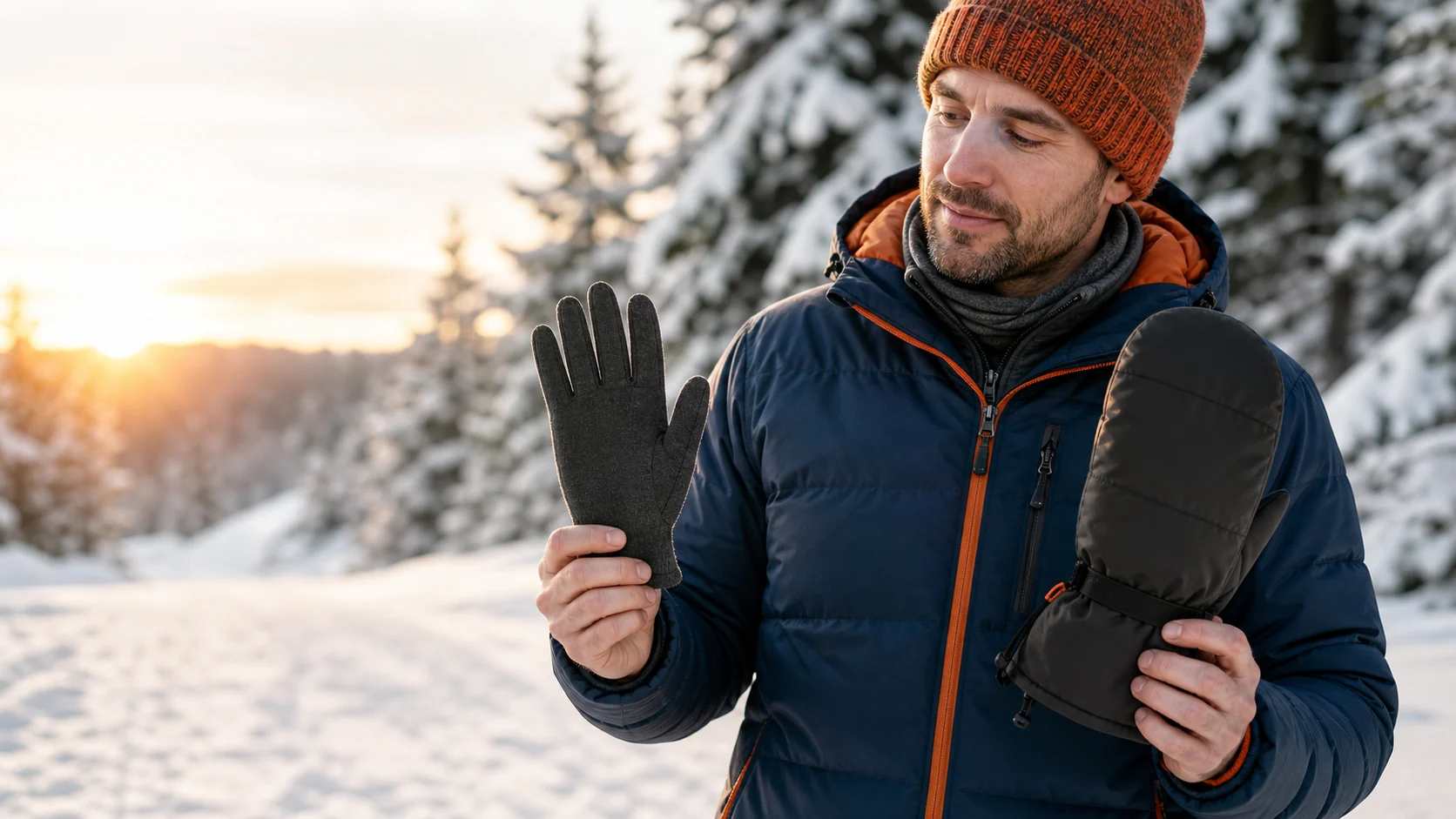
The phrase “glove liner” covers several different products: a very thin base glove under a ski mitten, a work-glove insert, a lightweight merino glove worn alone, or a touchscreen layer used when an outer mitten comes off. Current US search results mix all of them together. That is why a recommendation based only on material or star rating can miss the real question.
The useful question is not “Are liners warm?” It is “Will this liner improve my complete hand system in my weather, activity, and outer glove?” A liner is one component. Its result depends on space, circulation, moisture, wind protection, and how often you expose your hands.
How do glove liners make hands warmer?
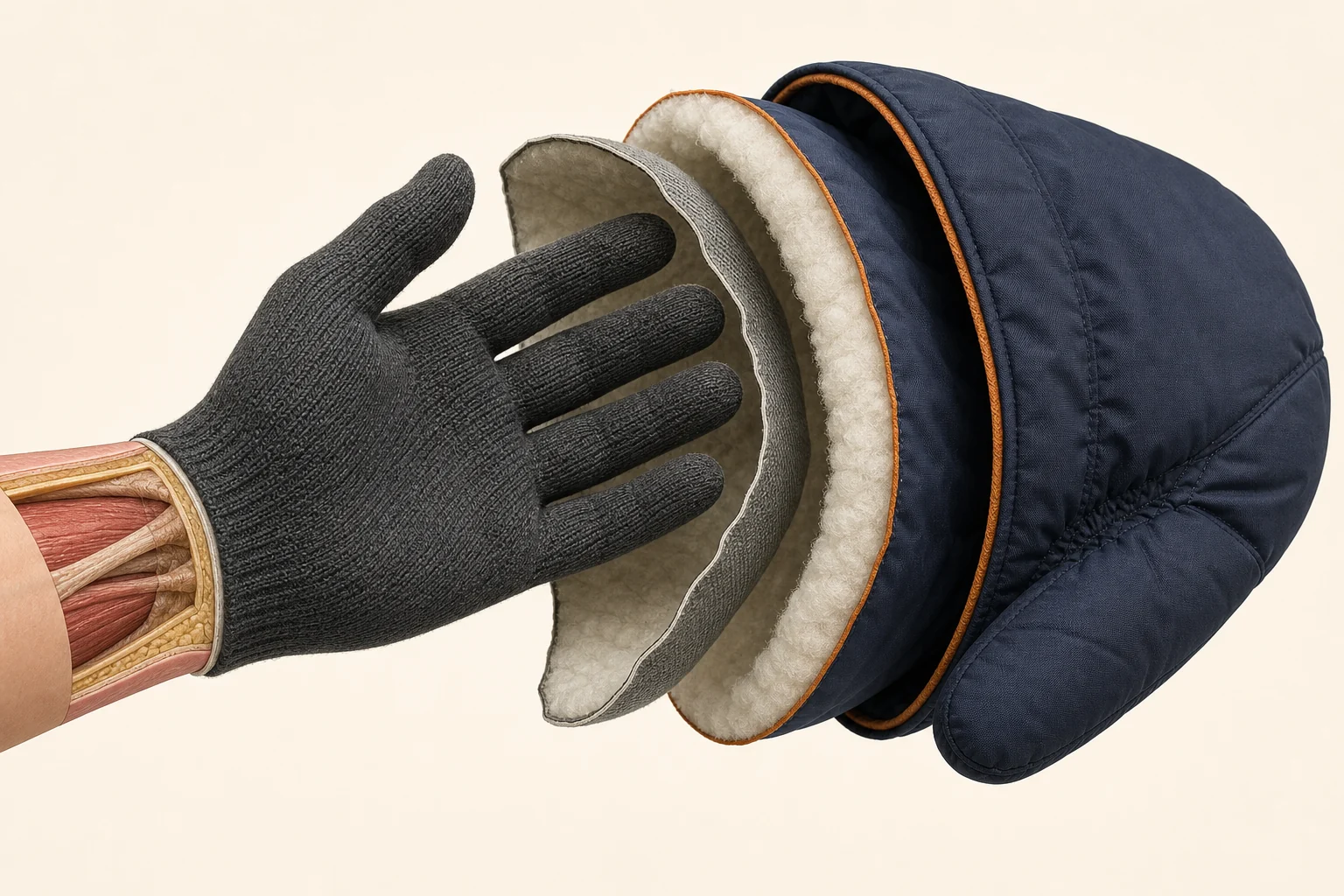
A liner can help in three different ways. First, it adds a small amount of insulation and another boundary that slows heat movement. Second, an appropriate next-to-skin fabric can move perspiration away from the skin more effectively than a clammy outer-glove lining. Third, it keeps a layer over the hand when you temporarily remove the outer glove or mitten.
That third benefit is easy to underestimate. During a winter outing, many people repeatedly remove a bulky glove to unlock a car, use a camera, tighten a strap, open a snack, or operate a phone. A thin liner does not turn that moment into warm indoor comfort, but it reduces direct bare-skin exposure and can make the task less abrupt.
OSHA’s cold-stress guidance recommends loose-fitting clothing in layers. It also explains that tight clothing reduces circulation to the extremities, while inner layers should help move moisture and outer layers should protect against wind and rain. The same system logic applies to hands: the liner, insulation, and shell must work together.
The inside of an outer glove has finite space. A liner only helps if enough space remains for insulating loft and blood flow. If adding the liner turns a comfortable glove into a tight glove, the extra fabric can reverse the intended benefit.
When can glove liners make your hands colder?
The most common failure is overfilling the outer glove. You put on a liner, the fingertips press into the ends, the thumb web feels tight, and the outer insulation is flattened. The hand may initially feel wrapped and secure, then become colder as circulation and loft decline.
Moisture is the second failure. A liner can absorb or transport sweat, but it cannot make moisture disappear. If hard activity makes the entire system damp and the outer layer has little ventilation, the hands may cool rapidly when you stop moving. OSHA specifically warns that wetness and perspiration can contribute to heat loss.
The third failure is using a liner as a shell. Most thin knit liners are not designed to block strong wind, wet snow, or prolonged contact with water. They may feel comfortable during a short dry walk and fail on a windy platform or while clearing wet snow.
Watch for these signs that your liner system is wrong:
- fingertips press firmly into the outer glove;
- the hand tingles, feels numb, or becomes unusually pale;
- you cannot spread the fingers or make a relaxed fist;
- the liner bunches at the palm or pulls out when the shell comes off;
- the inside feels damp after moderate activity;
- wind passes through both layers;
- the cuff combination leaves the wrist exposed.
If numbness, unusual clumsiness, persistent pain, or skin-color changes appear in the cold, move to shelter. The National Weather Service notes that frostbite commonly affects exposed or poorly protected extremities such as the hands and feet. A shopping decision should never replace cold-injury judgment.
How should glove liners fit?
A liner should sit close to the skin without creating pressure. The fingertips should reach near the ends, the seams should not dig into the fingers, and the wrist should remain covered when you move. Close fit improves control and helps a touchscreen patch make contact, but “close” is not the same as compressive.
Test the liner inside the exact outer glove you plan to use. Sizes are not standardized across brands, and the same liner can fit under one mitten but overload another. Do not size up the liner until it wrinkles; instead, choose an outer glove with enough internal volume for layering.
- Put on the liner and outer glove, then wait until the materials settle.
- Spread the fingers, make a fist, and flex the wrist.
- Pinch a zipper pull, hold a key, and grip the object used during the activity.
- Press each fingertip gently; it should not already be hard against the outer end.
- Remove the outer glove. The liner should stay on without twisting or pulling inside out.
- Recheck after ten minutes for tingling, pressure, or dampness.
If your current gloves already fit snugly without a liner, a thinner insert may still be too much. A roomier mitten, a purpose-built layered system, or a warmer replacement glove is usually a better route than forcing two tight layers together.
Which glove-liner material is best?
No material is best for every person. Choose by sweat level, drying needs, durability, sensitivity, and how the liner feels inside the outer glove.
| Material | Useful strengths | Common limits | Good starting use |
|---|---|---|---|
| Merino wool or wool blend | Comfortable across changing activity; odor resistance; useful warmth for low bulk | Fine knits can wear faster at fingertips; quality and blend vary; may cost more | Mixed activity, travel, everyday layering |
| Synthetic knit | Usually quick drying, durable, and affordable; easy to make very thin | Can retain odor; warmth and feel vary widely by fabric | High-output activity, frequent washing, work |
| Silk | Very thin and smooth under a tight outer layer | Often less durable for abrasion; modest insulation by itself | Minimal-bulk layering when space is limited |
| Fleece | Soft and warm for its price; comfortable alone in dry, mild cold | Bulkier; may reduce dexterity or overfill the shell | Roomy mittens, low-output everyday use |
| Conductive touchscreen blend | Can keep the hand covered during short phone tasks | Performance depends on fit, contact area, device, moisture, and screen protector | Commuting, navigation, brief device use |
Look beyond the fiber headline. A 100% material label does not tell you knit density, seam placement, drying speed in the full system, or durability at the fingertip. Blends often exist to balance stretch, wear, moisture handling, and touch performance.
Manufacturer care instructions also differ. Follow the label for the specific liner instead of assuming every wool or synthetic product can use the same wash cycle. Heat can shrink or damage some fibers and can degrade conductive fingertip treatments.
For a deeper material decision, use our wool-versus-synthetic glove guide.
Are liners better under gloves or mittens?
Liners usually fit more easily under mittens because four fingers share one large chamber. That chamber offers more space for insulation and lets the fingers share warmth. A five-finger outer glove gives better control but creates five narrow compartments, so adding a liner is more likely to compress the fingertips.
For stationary cold, photography, lift rides, or spectating, a thin liner under a roomy insulated mitten is a strong starting point. The mitten stays on for warmth; the liner remains when you need a brief dexterity task. Wrist leashes reduce the chance of dropping the mitten.
For shoveling, tools, poles, or vehicle controls, a five-finger outer glove may be necessary. Choose the liner and glove as a tested pair. The benefit of independent fingers disappears if the combined layers are too bulky to grip safely.
Three-finger or lobster-style gloves occupy the middle ground. They share warmth between some fingers while preserving more control than a full mitten. Our gloves-versus-mittens comparison covers that tradeoff in detail.
Can you wear glove liners by themselves?
Yes, in mild, dry conditions or during high-output activity—but the word “liner” should not be mistaken for a weather rating. A thin liner worn alone can work for a short walk between heated spaces, cool-weather running, setting up equipment, or a task that needs fine finger control.
It is usually a poor standalone choice in strong wind, wet snow, freezing rain, or prolonged stationary exposure. Open knits let moving air strip heat. Thin palms can wear quickly against rough tools, and many liner fabrics lack the grip needed for a wet handle.
A practical strategy is to treat a liner as the lowest-protection mode in a modular system. Wear it alone while active, add the outer glove when wind or precipitation begins, and add or switch to a mitten when activity drops. Carry the outer layer where it stays dry and accessible—not buried at the bottom of a bag.
Do touchscreen glove liners actually work?
They can, but the result depends on conductive material making close, clean contact with both the finger and the screen. A loose fingertip creates a small air gap; moisture, cold-stiffened fabric, a thick screen protector, or a worn conductive patch can also reduce response.
Test the exact liner with your phone during the return window. Check taps near the corners, short typing, swipes, camera controls, and navigation gestures. A liner that opens one app but makes typing unreliable may not satisfy the real task.
Touchscreen ability is most valuable when it prevents full hand exposure. If a short phone task can be completed in the liner while the mitten hangs from a wrist leash, the system preserves more warmth than removing every layer. For troubleshooting, see why touchscreen gloves stop working.
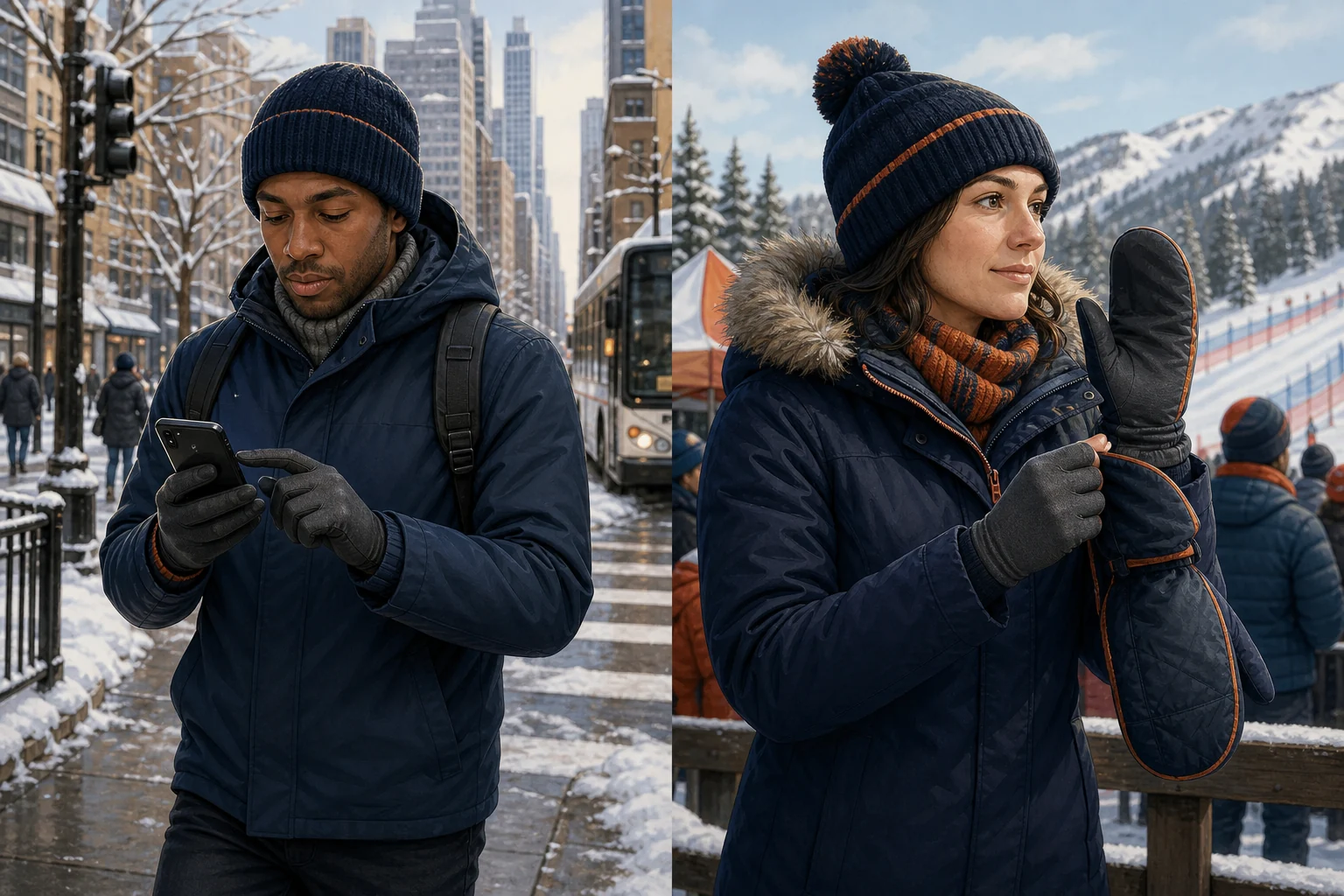
Which glove-liner system fits your activity?
| Use case | Useful starting system | Main problem to prevent |
|---|---|---|
| Urban commuting | Thin touchscreen liner plus wind-resistant outer glove carried nearby | Bare-hand phone use and platform wind |
| Dog walking | Close liner under a roomy grippy glove or mitten | Poor leash control and sudden hand exposure |
| Skiing or snowboarding | Moisture-managing liner under a verified waterproof insulated glove or mitten | Wetness, wind, and cooling on lift rides |
| Snow shoveling | Thin quick-drying liner under a weather-resistant work glove with secure palm | Sweat accumulation and slippery tools |
| Stationary spectating | Thin liner under a roomy high-insulation mitten | Low heat production over time |
| Winter running | Breathable liner-style glove alone, with wind shell available | Overheating early and chilling after slowing |
| Photography | Dexterous liner under a leashed flip-back or removable mitten | Repeated bare-hand exposure |
A liner may add only modest insulation, yet still improve the whole system by keeping skin covered during short dexterity tasks. Judge it by both steady-state warmth and the number of bare-hand moments it prevents.
Plan for the coldest low-output moment, not only the most active part. A liner that feels perfect while walking uphill may be insufficient during a delayed bus, a long dog-sniff stop, a ski-lift ride, or a vehicle problem. Conversely, maximum insulation chosen for standing still may cause heavy sweat during shoveling or climbing.
When should you replace the whole glove system instead of adding a liner?
A liner is a targeted upgrade, not a repair for every weak glove. Replace or change the outer system when:
- the existing glove is already tight;
- wind passes easily through the outer fabric;
- the activity involves wet snow or water and the glove lacks suitable moisture protection;
- insulation has packed down or shifted;
- the cuff does not overlap the jacket;
- the palm cannot safely control the tool or steering surface;
- the lining stays wet and cannot be removed or dried;
- you need a mitten’s shared finger warmth rather than another thin layer;
- the consequences of failure require purpose-built protective equipment.
If hands stay cold despite a dry, roomy, protective system, investigate fit, activity level, sweat, and circulation before buying more bulk. Our guide to why hands stay cold inside winter gloves provides a step-by-step diagnosis.
How can you test a glove-liner system before relying on it?
Start indoors during the return window. Put on the full system for ten to fifteen minutes. Perform the actual hand tasks: hold a shovel handle, clip a leash, operate a phone, open a zipper, turn a car key, or adjust a camera. Pressure, bunching, and lost grip usually appear before cold testing.
Then make a short outdoor test near shelter in conditions milder than the system’s intended maximum. Notice four transitions: the first five minutes, the point when activity raises heat, the moment you stop, and the period after the outer glove comes off. Check whether the liner stays dry enough, whether the outer layer is easy to replace, and whether fingers remain comfortable rather than merely numb.
Do not use numbness as evidence that a glove is warm. Numb fingers can feel less uncomfortable while cold injury risk rises. Stop the test if you notice persistent tingling, pain, unusual clumsiness, pale or waxy skin, or color that does not return safely after warming.
- Keep: the full system stays comfortable, dry enough, and controllable through activity changes.
- Exchange the liner: it wrinkles, pulls out, irritates seams, or fails the needed touchscreen task.
- Exchange the outer glove: the liner fits alone but the combined system compresses fingers or insulation.
- Choose a different system: wind, wetness, duration, or safety consequence exceeds what either layer is built to handle.
Where does CozyGalar fit in this decision?
CozyGalar men’s wool-blend gloves are fleece-lined everyday winter gloves, not purpose-built thin liners and not certified severe-weather shells. They are designed for cool-to-cold routines such as commuting, driving, errands, and dry dog walks, with conductive fingertips and a textured palm.
If you need one comfortable five-finger glove for ordinary everyday use near heated spaces, that can be simpler than assembling a liner system. If you need wet-weather protection, prolonged stationary warmth, skiing, mountaineering, or a verified windproof shell, choose purpose-built equipment for those conditions.
Do not force CozyGalar gloves inside a tight outer glove. A roomy mitten may accommodate an everyday glove as an inner layer, but the combination must pass the same circulation, loft, dexterity, and moisture tests described above. CozyGalar is not marketed as a dedicated liner.
Need an everyday fleece-lined glove?
See CozyGalar’s current sizes, verified listing details, price, and availability on Amazon. For severe wind, wet snow, or long stationary exposure, choose a purpose-built outer system.
Commercial disclosure: CozyGalar makes the glove linked above. This is a direct brand-owned Amazon link, not an affiliate-commission link. We receive no commission from the external editorial or safety sources in this guide.
Frequently asked questions
Can I wear two glove liners at once?
Only if the outer glove remains roomy and both liners stay smooth. Two thin layers that create pressure are worse than one well-fitting liner. A roomier insulated mitten is usually the cleaner upgrade.
Should glove liners be skin tight?
They should be close fitting, not restrictive. You should have full movement without tingling, pressure at the fingertips, or deep seam marks.
Are merino wool liners warmer than synthetic liners?
Not automatically. Knit density, thickness, fit, moisture, wind, and the outer shell matter as much as the fiber name. Merino may suit mixed activity and odor control; synthetics often dry quickly and resist wear.
Do glove liners need to be waterproof?
Usually the outer glove or mitten supplies weather protection. A waterproof liner could trap moisture next to the skin and add bulk. Match the entire system to the wetness, not one layer in isolation.
How many pairs of liners should I carry?
For a long outing, a dry spare can be more useful than a second layer worn at the same time. Store it in a protected bag or inside pocket so it remains dry.
Can glove liners help with Raynaud’s?
Some people value the extra layer and reduced bare-skin exposure, but cold response varies and a liner is not medical treatment. Ask a qualified clinician about cold exposure and seek purpose-built protection appropriate to your situation.
Sources and research notes
CozyGalar did not laboratory-test every liner material or system discussed here. We used OpenSEO US keyword and SERP evidence refreshed August 22, 2026, current ranking-page coverage, primary cold-safety guidance, and verified CozyGalar product facts. Manufacturer warmth percentages and product-page superlatives were treated as claims rather than universal facts.