

Winter vehicle troubleshooting
How Do You Thaw Frozen Windshield Washer Fluid Safely?
Stop cycling the washer pump, move the vehicle somewhere above freezing, and let the reservoir, lines, and nozzles thaw completely. Then inspect for leaks and replace the old fluid with a labeled winter formula chosen for the temperatures you expect.
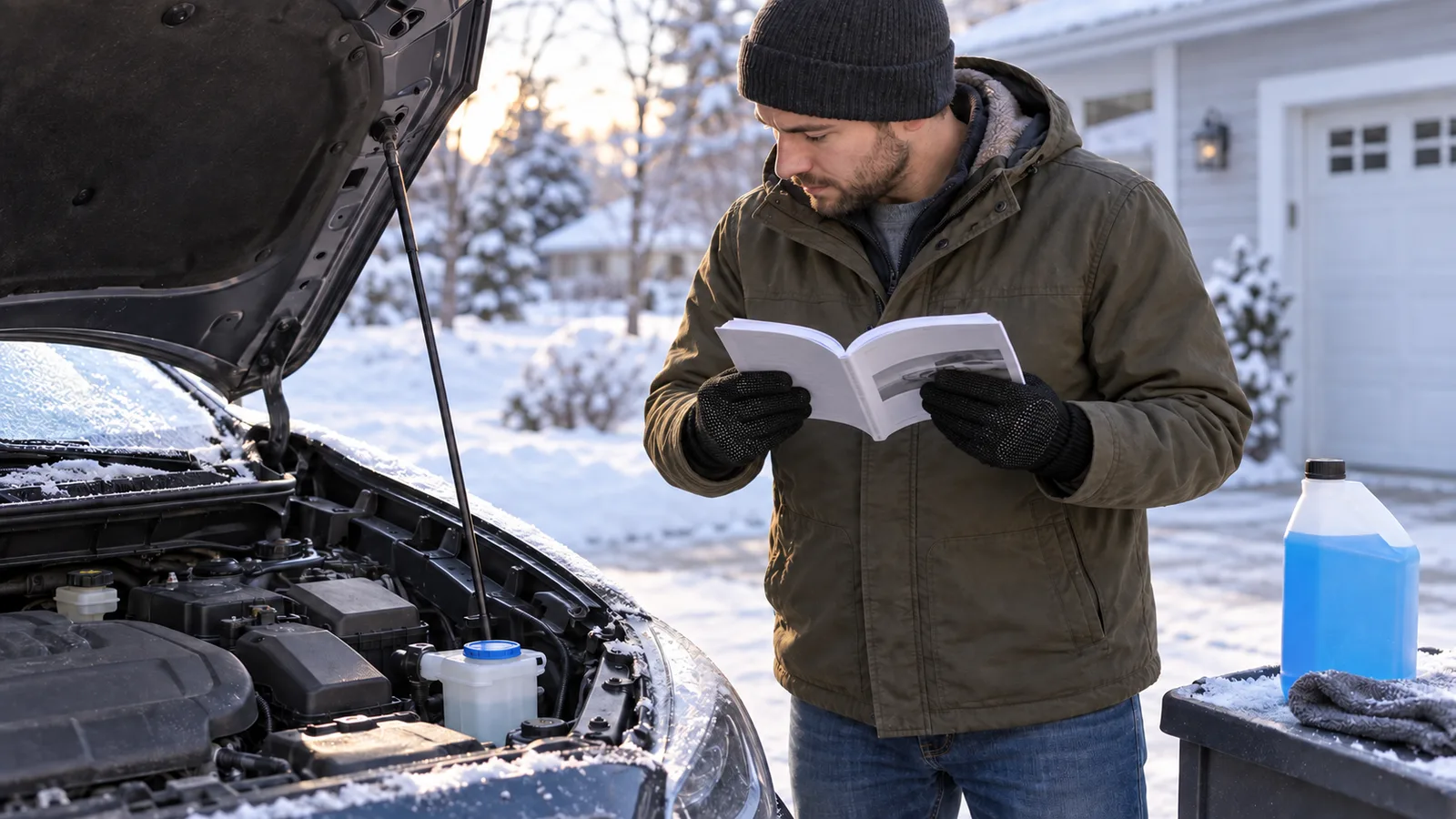
The safest general fix is slow, complete thawing. Stop pressing the washer control, park in an above-freezing garage or service bay, and wait until the tank, hoses, and nozzles are liquid again. Follow the vehicle manual, check for cracks or leaks, then replace the old mix with commercially labeled winter washer fluid. Do not pour boiling water into the system or improvise with alcohol, coolant, or household chemicals.
How Can You Tell Whether the Washer Fluid Is Actually Frozen?
Do not assume every winter no-spray problem is ice. Start with what you can observe while the vehicle is parked, the engine is off, and the hood is safely supported according to the owner’s manual. Check the fluid level and look through the reservoir wall if it is visible. Slush or solid ice strongly suggests a frozen tank. A fully liquid tank does not rule out ice in a narrow hose or nozzle.
Next, notice what happened before the failure. Did the system stop after an overnight freeze? Was summer formula or water added recently? Does one nozzle work while another does not? Is there a puddle under the vehicle? Did you hear the pump before you stopped testing? These clues narrow the problem without forcing the system.
| What you observe | Likely area to check | Safe next step | Stop condition |
|---|---|---|---|
| Reservoir looks slushy or solid | Fluid in the tank is frozen | Move the vehicle above freezing and allow a full thaw | Do not chip the reservoir or add boiling water |
| Tank is liquid, but neither nozzle sprays after a cold soak | Lines or nozzles may be frozen | Thaw the entire vehicle, not only the tank | Stop cycling the pump while the blockage remains |
| One nozzle is weak or dry | Localized ice, debris, kink, or disconnected hose | Thaw first; then inspect using the service manual | Do not enlarge a nozzle with an improvised tool |
| No pump sound after everything is thawed | Fuse, switch, wiring, or pump fault | Check the manual or schedule diagnosis | Do not assume more fluid will fix an electrical fault |
| Fluid appears under the car or level drops | Cracked tank, hose, fitting, or pump seal | Stop using the system and arrange repair | Keep people and pets away from the spill |
What Should You Do First When the Washer System Will Not Spray?
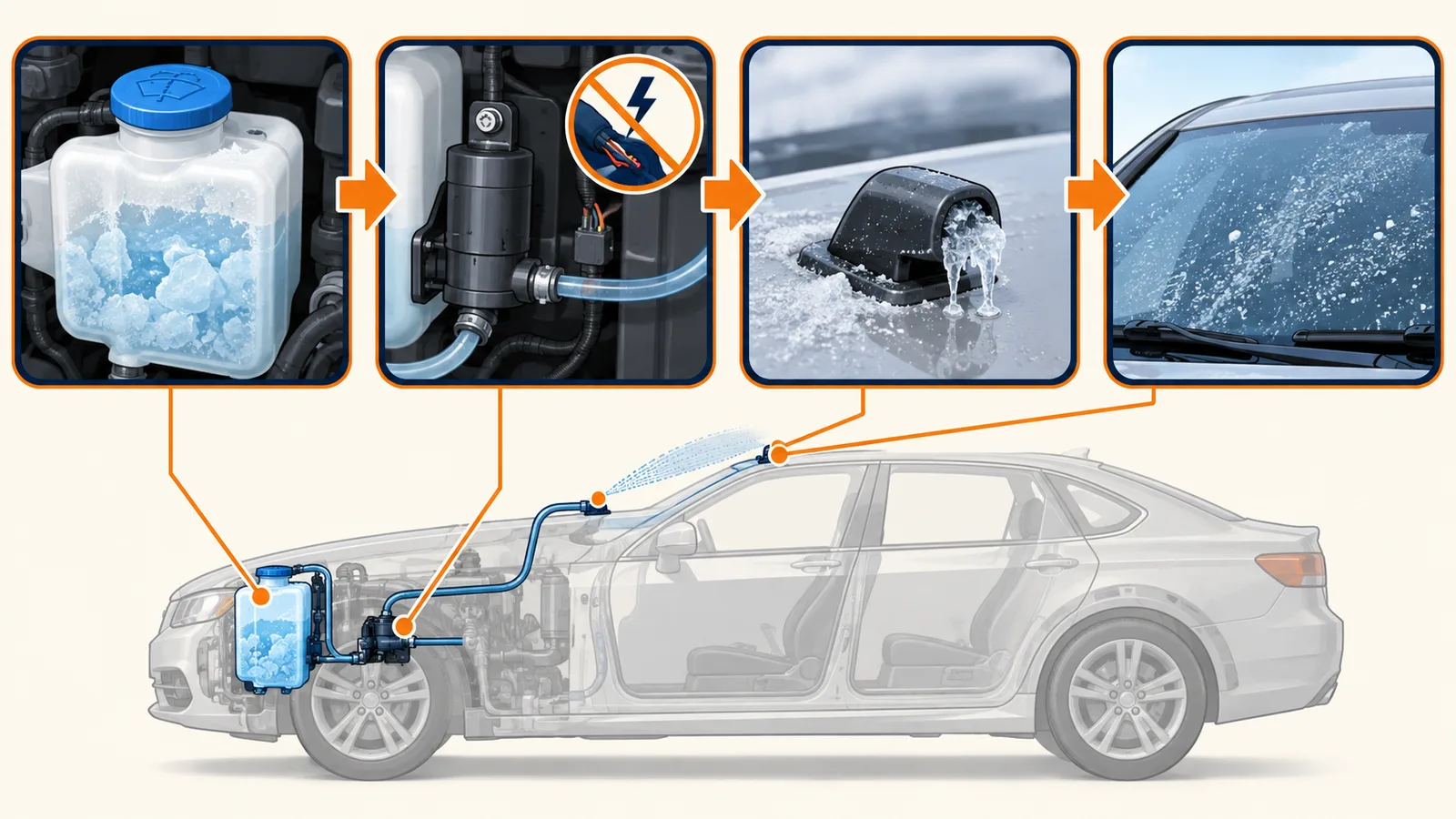
- Stop operating the control. Repeated attempts against ice or another blockage can stress the washer pump and do not tell you where the fault is.
- Park somewhere safe. Do not begin an under-hood check on the shoulder of a busy or slippery road.
- Read the vehicle manual. Confirm the reservoir location, approved fluid, fuse information, hood support, and any model-specific cautions.
- Move the vehicle above freezing. A heated garage or service bay is the least aggressive general way to thaw the entire washer path.
- Keep the fluid away from children, pets, heat, and flame. Many winter washer fluids contain toxic and flammable alcohols.
If you do not have a warm garage, ask a repair shop, parking facility, or other authorized indoor location whether it can accommodate the vehicle. Engine heat alone may not reach a hood nozzle or exposed line evenly, and idling a vehicle creates exhaust risks. Never idle in an enclosed garage.
What Is the Safest Way to Thaw the Reservoir, Lines, and Nozzles?
Give the whole vehicle enough time in an above-freezing environment. A partly thawed reservoir can leave ice in a hose or nozzle, so a brief warm-up is not proof that the system is ready. Keep the ignition and washer control off while you wait unless the vehicle manual gives a different procedure.
After the vehicle has warmed, inspect the reservoir, cap, visible hoses, and the area beneath the car. Look for splits, loose connections, or dripping fluid. If the system appears intact, test it once while parked. A normal pump sound and an even spray suggest the path is open. A hum with no spray still points to a blockage or leak; silence points toward a fuse, switch, wiring, or pump issue.
Targeted heat can damage plastics, wiring, paint, or glass when it is too hot, too close, or left unattended. Because reservoir locations and surrounding components vary, this guide does not prescribe a hair dryer, heat gun, lamp, heating pad, or other appliance. Use only a method permitted by the vehicle manufacturer or have a technician handle it.
Should You Add Hot Water, Rubbing Alcohol, or Antifreeze?
No. Do not pour hot or boiling water on the windshield or into the washer reservoir. Rapid temperature change can stress cold glass, and hot liquid can damage or deform vehicle materials. Adding water also raises the mixture’s freezing point, making another freeze more likely.
Do not create a home recipe with rubbing alcohol, methanol, vodka, fuel-line antifreeze, engine coolant, or de-icer that is not labeled for the washer system. Online forums frequently recommend these shortcuts, but concentration, compatibility, toxicity, flammability, paint effects, and local disposal requirements vary. A washer reservoir is not the place to improvise a chemical formula.
If washer fluid is swallowed or tasted, use the US Poison Control online tool or call 1-800-222-1222 immediately. Call 911 for collapse, trouble breathing, seizures, or another emergency. Do not wait for severe symptoms; methanol effects can be delayed.
What Should You Check After the System Thaws?
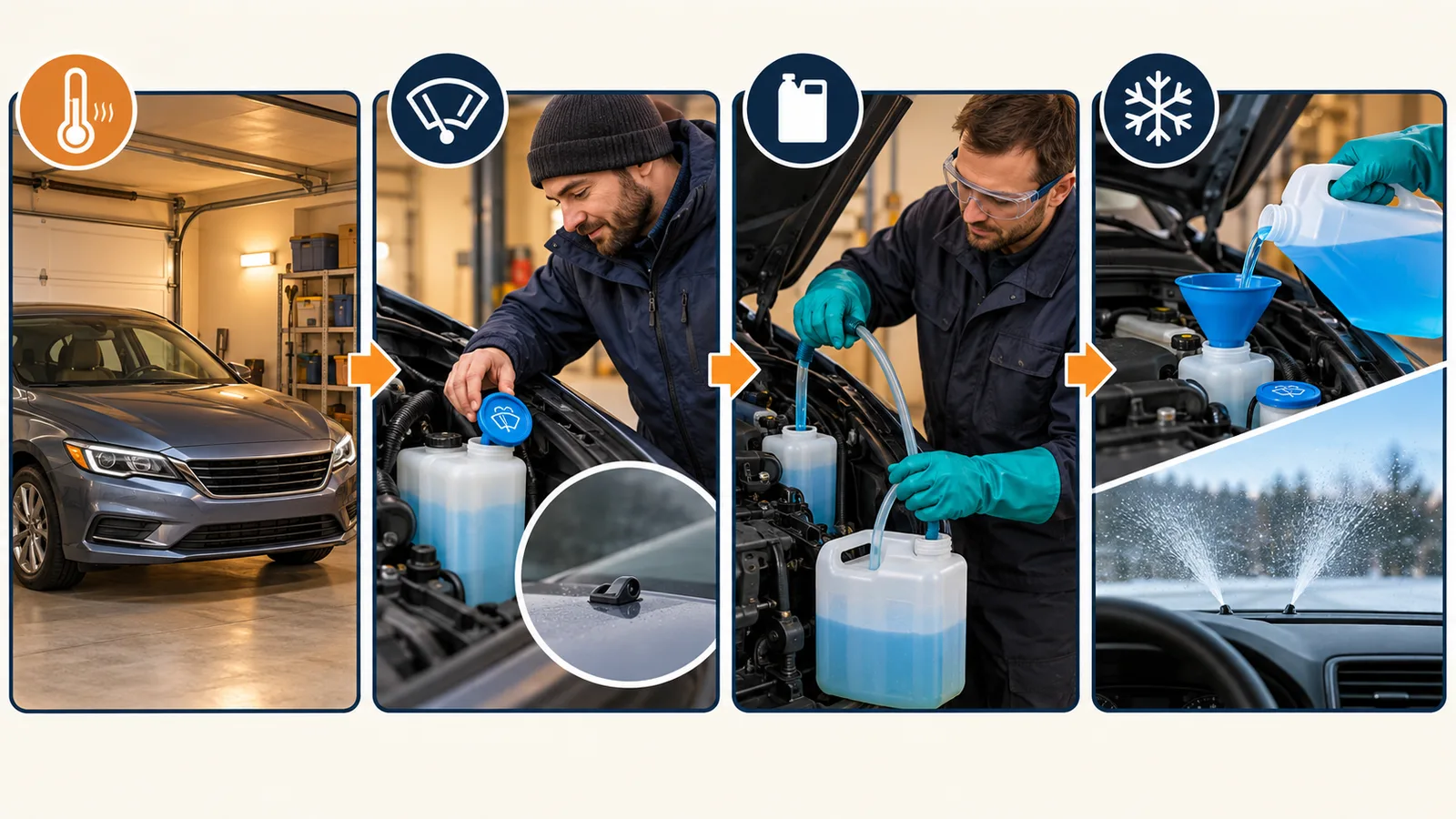
First, verify that the reservoir and visible lines are not cracked and that no fluid is collecting underneath the vehicle. Freezing liquid expands; a previously sound-looking system can leak only after it becomes liquid again. If you see a leak, stop and arrange repair rather than topping it off.
Second, deal with the old mixture. The method depends on the vehicle. Some reservoirs can be emptied with a label-compatible transfer pump; others are difficult to access without removing trim or components. Follow the service manual and local household hazardous-waste rules. If you cannot remove the old fluid without spills or unapproved disassembly, use a qualified technician.
Third, add only commercially formulated washer fluid approved for the vehicle and season. Use a clean funnel, avoid overfilling, close the cap, and test the system while parked. Spray enough to move the winter formula through the lines and nozzles only after the system is confirmed open.
How Do You Choose Washer Fluid That Will Not Freeze Again?
Read the front label and directions rather than relying on color. Choose a ready-to-use or properly diluted concentrate whose stated freeze protection is below the lowest temperature reasonably expected on your route and where the vehicle is parked. Confirm that the product is suitable for your vehicle; some cameras, sensors, coatings, or washer systems may have manufacturer-specific requirements.
Do not assume that topping off with a stronger winter product gives the full number printed on its label. That rating applies to the labeled concentration. This is an inference from mixture behavior: leftover summer fluid, plain water, or an unknown blend changes the final concentration. When reliable low-temperature performance matters, remove the unsuitable fluid and move the correct product through the whole system.
Michelin’s current winter-prep guidance recommends winter-rated washer fluid and warns that summer fluid can freeze in the reservoir or on the windshield. That is manufacturer guidance, not an independent product test. The correct rating still depends on your climate, forecast, vehicle manual, and the product label.
When Is It a Pump, Fuse, Hose, or Nozzle Problem Instead?
If the vehicle has thawed completely and the correct fluid is liquid, continue diagnosis instead of adding more chemicals. A full reservoir plus a silent pump can point toward a fuse, switch, connector, wiring, or pump failure. A running pump with no spray can point toward a blocked or disconnected hose, clogged nozzle, or leak. One weak nozzle suggests a more local restriction.
Use the owner’s manual for the fuse location and service limits. A fuse that fails again is a symptom, not a permanent repair. Do not replace it with a higher rating. Avoid probing electrical connectors or pressurized lines unless the service procedure and your skill level support it. A technician is the right next step when the reservoir is buried, the system leaks, the pump stays silent, or a blockage remains after a full thaw.
Can You Drive With a Frozen Washer System?
Do not drive when you cannot keep the windshield clear. Winter road salt, spray, slush, and grime can erase visibility quickly even after you scrape the glass at home. NHTSA advises preparing the vehicle, checking conditions, and postponing non-essential travel when roads are unsafe. A frozen washer system is especially serious when the route is wet, salted, or actively snowing.
If the glass is clean, the weather is dry, and local rules permit travel, the decision still depends on the route and how quickly visibility could deteriorate. This article cannot authorize a trip or replace local law, the owner’s manual, emergency guidance, or professional vehicle advice. When in doubt, thaw or repair the system before leaving.
Where Do Everyday Winter Gloves Fit Into This Task?
For a dry visual inspection—reading the manual, opening the hood as directed, or checking whether the reservoir looks slushy—an ordinary winter glove can make the cold task more comfortable. CozyGalar gloves are fleece-lined and made from 20% merino wool, 10% elastane, 5% conductive fiber, and 65% polyester. They include textured grip and conductive fingertips designed for compatible phones and tablets.
Those features do not make them chemical-resistant, waterproof, windproof, mechanic’s, or extreme-cold gloves. Remove them before handling washer fluid if the product label calls for chemical-resistant gloves, and use eye protection and other PPE specified by the label or SDS. If the knit gloves are splashed, stop using them and follow the chemical product’s exposure instructions; do not treat washing the glove as proof that it is safe to wear.
Need an everyday layer for dry winter routines?
Check the current CozyGalar listing for price, sizes, and availability. These are brand-owned commercial links, and CozyGalar does not earn an affiliate commission from them. The gloves are for ordinary dry cold—not washer-fluid handling or chemical protection.
What Is the Five-Minute Prevention Checklist?
- Check the forecast low where the vehicle will sit and where you will drive.
- Read the washer-fluid label; do not judge the formula by color.
- Remove summer fluid or an unknown diluted mix before a hard freeze.
- Run the correct winter fluid through the lines and nozzles while parked.
- Keep a sealed spare bottle upright and secured away from children and pets.
- Inspect spray pattern, wiper condition, and fluid level before a winter trip.
- Never use the washer control against a known frozen blockage.
- Do not drive if road spray or weather can obscure a windshield you cannot wash.
Washer-fluid freezing is only one winter visibility problem. Use the separate guide to remove windshield ice safely, the step-by-step winter windshield defogging guide, and the winter car emergency-kit checklist for the rest of the routine.
Sources and editorial notes
- NHTSA: Winter Weather Driving Tips
- CDC/NIOSH: Methanol Emergency Response Safety and Health Database
- Poison Control: Windshield Washer Fluid — A Winter Hazard
- Prestone: All Season 3-in-1 Windshield Washer Fluid Safety Data Sheet
- Michelin: Winterize Your Car — Fluid, Battery, and Visibility Checks
Sources and current US search results were checked September 17, 2026. This article offers general winter-vehicle information; it does not replace the vehicle owner’s or service manual, a chemical label or SDS, professional repair, emergency guidance, Poison Control, or local law. Ranking pages were used to map questions and gaps, not as proof of CozyGalar product performance. Original AI-assisted images were created with brand-owned CozyGalar glove references; they are editorial illustrations, not first-hand testing or a third-party collaboration.