
Why Do My Hands Sweat in Winter Gloves and Then Feel Cold?
Your glove, activity level, and hand moisture may be mismatched even when the insulation seems warm enough.
Your hands sweat in winter gloves because the glove traps some of the heat and humidity your skin produces. If its insulation exceeds the warmth your activity requires, or moisture cannot escape fast enough, the lining becomes damp. When you slow down, stop at a bus shelter, or face wind, evaporation and wet fabric increase heat loss. A glove that felt warm while moving can suddenly feel cold.
This “warm, sweaty, then freezing” cycle is common because shoppers usually choose handwear from the air temperature alone. Temperature matters, but so do walking pace, wind, wet contact, fit, waterproof barriers, and the heated spaces you pass through. The right answer is rarely “buy the thickest glove.” It is to keep your hands inside a workable activity window: warm enough at rest, but not so insulated that ordinary movement soaks the lining.
Why do hands sweat inside winter gloves?
Gloves create a small climate around the hand. Your skin gives off moisture vapor even when it does not look wet. Activity raises heat production, and sweat increases as your body tries to regulate temperature. Insulation slows heat loss; closely woven faces, coated palms, and waterproof membranes can also slow vapor movement. None of those features is automatically bad. The problem appears when the system retains heat or moisture faster than your activity and the outside air can remove it.
Four causes account for most everyday cases:
- Too much insulation for the output. A glove chosen for standing still may be excessive during fast walking, shoveling, cycling, or running.
- Limited moisture escape. A waterproof barrier protects against rain and wet snow but can feel clammy when internal vapor production exceeds its transfer rate.
- Warm-to-cold transitions. Putting gloves on inside a heated home, car, or train can start the sweating before you reach winter air.
- Unusually high palm sweating. Some people sweat more than a glove system can manage; persistent excessive sweating can be a medical condition called hyperhidrosis.
Fit can add a fifth problem. A tight glove compresses insulation, leaves little air space, may reduce comfortable movement, and can make the lining cling to damp skin. Our separate winter-glove fit guide explains how to check fingertip space and palm tension.
Why do sweaty hands feel colder after you stop moving?
While you are active, your muscles keep generating heat. Moisture on the skin and in the lining may feel merely warm or clammy. Once you stop, heat production falls but the moisture remains. Evaporation requires energy, and moving air accelerates the cooling. Damp fabric also changes how the glove feels against the skin and can reduce the useful loft of some insulation.
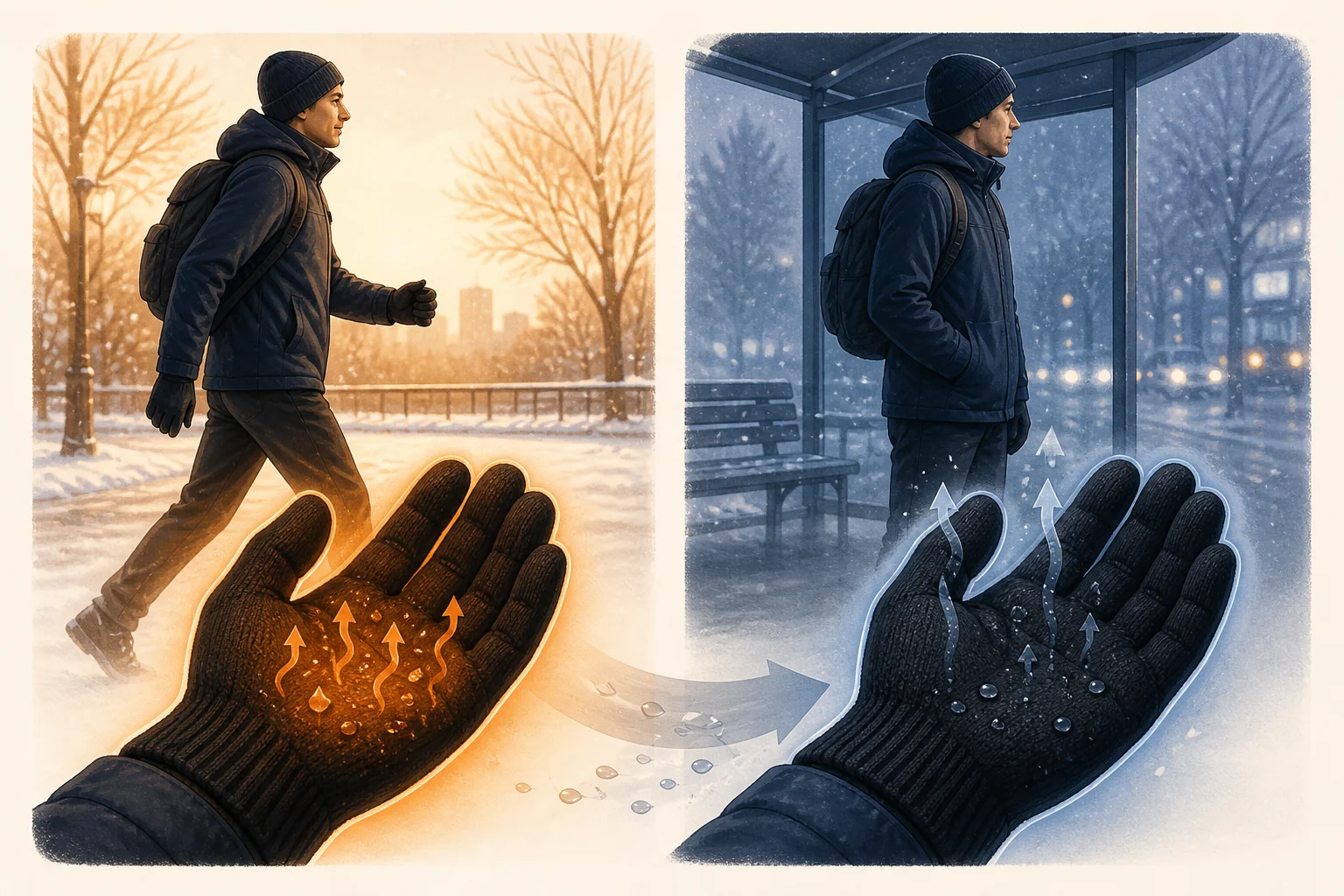
REI explicitly warns that sweaty hands and gloves cool quickly when movement stops, and recommends choosing insulation for the activity rather than wearing mountaineering-weight mittens for high-output exercise. Zanier makes the same connection: more insulation is not always more comfort when activity creates enough heat to produce sweat.
CozyGalar insight: the stop phase is the real test
Judge a glove after the complete routine, not only during the first ten minutes. If your hands are warm on the walk but cold while waiting for a train, holding a dog leash at a crossing, or loading the car, the system probably overshot your active heat demand.
Is the moisture sweat or outside water?
Before changing gloves, identify where the water came from. “My glove is wet” can describe four different failures.
| Moisture path | Clue | First response |
|---|---|---|
| Sweat | Both palms become evenly damp after faster movement; the outer surface may remain dry. | Reduce insulation, vent earlier, or switch layers before the lining becomes wet. |
| Cuff entry | Wetness begins at the wrist after snow, rain, or scraping a car. | Change jacket/glove overlap or use a longer adjustable cuff. |
| Face or seam leakage | A specific finger, seam, or back-of-hand area wets first during precipitation. | Use a verified waterproof glove or shell and inspect damage. |
| Wet-object transfer | The palm wets after gripping a slushy shovel, rail, leash, or car door. | Choose a palm and shell suited to prolonged wet contact. |
Try one short controlled outing in dry weather. Start with completely dry gloves, note when dampness begins, and compare palm, fingertips, wrist, and outer surface. This does not replace laboratory testing, but it separates the most likely pathway without guessing from marketing language.
What should you change first?
Start with the lowest-cost adjustment. Change one variable at a time so you know what worked.
- Start slightly cool, not overheated. Put gloves on immediately before the outdoor portion rather than ten minutes earlier in a heated room.
- Vent before you sweat. Loosen a cuff or briefly remove a layer at the first sign of clamminess; waiting until the lining is wet is too late.
- Use less insulation during high output. Brisk walking and running often need a lighter glove than standing, spectating, or slow dog walking at the same temperature.
- Protect against wind separately. In dry wind, a breathable wind-resistant shell may solve cooling without the moisture penalty of maximum waterproofing.
- Check fit. The glove should not pinch across the palm or pull tight at the fingertips. Adding a liner must not make the system restrictive.
- Carry a dry spare. On long outings, a second light pair can be more useful than forcing one damp pair through every phase.
- Dry the whole glove between uses. Open the cuff, follow the care label, and avoid starting the next day with residual lining moisture.
Do liner gloves, shells, and two pairs help?
They help when they create options rather than bulk. REI recommends a light or midweight liner under a warmer shell because the shell can be removed when activity raises heat output. The Survival Skills Guide similarly advises switching handwear with temperature and activity, bringing a spare, and using removable liners for drying.
A liner is not automatically a cure. If it makes the outer glove tight, circulation and dexterity may worsen. If both layers become saturated, you now have two damp layers. The useful system is modular: a thin layer you can wear alone, a shell you can add for wind or precipitation, and enough room for both without compression.
Material matters, but construction and use matter more than fiber slogans. Woolmark documents that wool can absorb and retain moisture vapor, including sweat. That can support comfort in a liner or wool blend, but it does not make an ordinary knit glove waterproof, nor can any fiber keep up indefinitely with heavy liquid sweat.
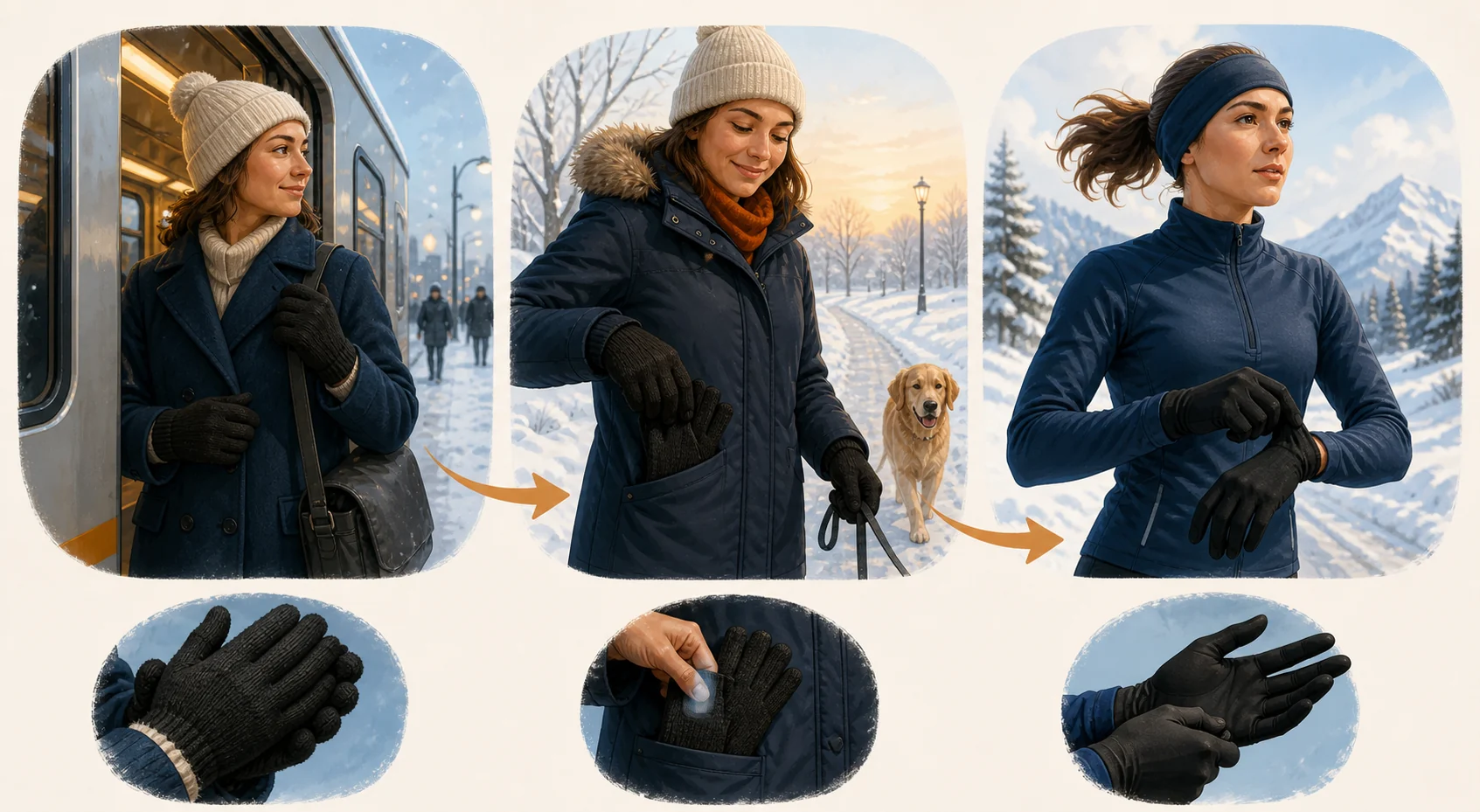
Which setup works for your winter routine?
Commuting
The hidden problem is the heated transition. Keep gloves in a pocket until you approach the exit, or loosen them during the indoor portion. For a short, mostly dry walk, a flexible knit or fleece-lined glove may be enough. Add a shell only when wind or precipitation demands it.
Dog walking
Dog walking is stop-start: brisk movement, pauses for sniffing, leash handling, and phone use. Use moderate insulation, maintain secure grip, and carry a spare on longer walks. If rain or wet snow is likely, prioritize verified water protection; see our dog-walking glove guide.
Running, cycling, shoveling, and hiking uphill
These are high-output activities. Start with lighter, more breathable handwear than you would use while standing at the same temperature. Make wind protection adjustable, and change before sweat accumulates. For cycling, remember that speed creates wind chill even after output falls.
Standing, spectating, and slow outdoor work
Low-output use may justify thicker insulation or mittens. But if the task alternates between heavy work and standing, use layers or two pairs instead of one fixed maximum-insulation glove.
Wet snow and rain
Do not confuse internal sweat with a reason to abandon water protection. Use only as much waterproofing as the exposure requires, but use a genuine barrier when liquid water is predictable. Our guide to whether knit gloves are waterproof explains the construction evidence to check.
When could sweaty palms be hyperhidrosis?
Occasional sweating inside a warm glove during activity is normal. Consider medical advice when palm sweating is excessive, persistent, affects daily tasks, occurs in cool conditions without an obvious activity trigger, or appears alongside new symptoms or a medication change. The International Hyperhidrosis Society notes that primary focal palmar hyperhidrosis can range from fingertip involvement to sweat that drips from the hand; excessive sweating may also be secondary to another condition or medication.
This article cannot diagnose the cause. Do not try prescription-strength treatments inside gloves without professional guidance: treatments can irritate skin and have contraindications. Seek prompt help for fingers that become numb, severely painful, waxy, very pale, blue, or do not rewarm normally, because those signs are not simply a glove-moisture problem.
Are CozyGalar fleece-lined gloves right for sweaty hands?
CozyGalar’s wool-blend knit gloves have a fleece lining, conductive fingertips, and a textured palm for everyday cool-to-cold routines such as commuting, driving, dog walking, and errands. They are not waterproof or windproof, and they are not designed as extreme-cold or high-output technical gloves.
For a person who sweats easily, that means the use case matters. They may suit a mostly dry, moderate-output routine when a soft lined glove is wanted. They may feel too warm during running, hard uphill movement, or mild shoulder-season weather. No glove can guarantee dry hands for someone with heavy palmar sweating. Begin with a short outing, note when dampness starts, and choose a lighter system if the lining becomes wet during the active phase.
What is the practical answer?
The warmest glove is not always the glove that keeps a sweaty hand warmest through the entire outing. Choose insulation for heat output, control moisture before the lining becomes wet, separate internal sweat from outside leakage, and keep a dry option for the stop phase. Persistent, disproportionate sweating belongs in a medical conversation, not an endless round of glove purchases.
Frequently asked questions
Should I wear cotton liners for sweaty hands?
Cotton can hold liquid moisture and dry slowly. A thin liner designed to manage moisture—often wool or a suitable synthetic—is generally a better starting point, provided it does not make the outer glove tight.
Do waterproof gloves make hands sweat more?
They can feel more humid during high output because a water barrier also limits how quickly vapor escapes. That does not mean waterproof gloves are defective; it means protection should match exposure and activity.
Why do only my palms sweat while my fingertips stay cold?
The palm has many sweat glands, while separated fingertips lose heat readily. Over-insulation around the palm, limited circulation from fit, wind exposure, or individual physiology can produce the uncomfortable combination. Persistent or severe symptoms deserve medical advice.
Should I size up to add a liner?
Only if the combined system otherwise compresses your hand. A liner should not create pinching across the palm or tension at the fingertips. Check the brand’s sizing guidance and test dexterity with both layers.
How many spare gloves should I carry?
For an ordinary commute, one dry spare light pair is usually enough. Longer outdoor trips may need multiple layers or removable liners. Plan for duration, precipitation, drying opportunities, and the consequence of losing dexterity.
Sources and methodology
We reviewed live US search results, detailed consumer and expert pages, Woolmark material information, and medical guidance. CozyGalar did not perform laboratory testing for this article.
- REI: How to Keep Your Hands Warm
- REI: Snow Gloves & Mittens, How to Choose
- Zanier: Warm Hands Without Sweating
- Survival Skills Guide: Cold Weather Glove System
- The Guardian: The Best Winter Gloves Are Two Pairs
- Woolmark: What Is the Wool Fibre?
- International Hyperhidrosis Society: Diagnosis Guidelines